
Best Feeding and Drinking Systems for Poultry Cages
Modern poultry farming is all about efficiency, hygiene, and good bird management. Whether you are running a small layer farm or a large commercial poultry operation, the feeding and drinking systems used in poultry cages can have a major impact on bird health, feed conversion, egg production, labor costs, and overall profitability.
For farmers using poultry cages, choosing the right poultry feeding and drinking system is therefore an important investment. A well-designed system ensures that every bird has easy access to clean water and sufficient feed while reducing wastage and contamination.
At Aaron Vet Farms Ltd, we understand that successful poultry production depends on proper housing, nutrition, biosecurity, and effective farm management.
Why Feeding and Drinking Systems Matter in Poultry Cages
Feed and water are the foundation of poultry production. Birds require continuous access to balanced feed and clean drinking water for healthy growth, strong immunity, and consistent production.
Traditional feeding and watering methods can create several challenges, including:
Feed wastage
Water spillage
Contaminated feed and water
Uneven access to feed
Increased labor requirements
Wet litter and poor hygiene
Higher operating costs
Modern poultry cage feeding systems and automatic drinking systems help solve many of these problems by making feeding and watering more controlled and efficient.
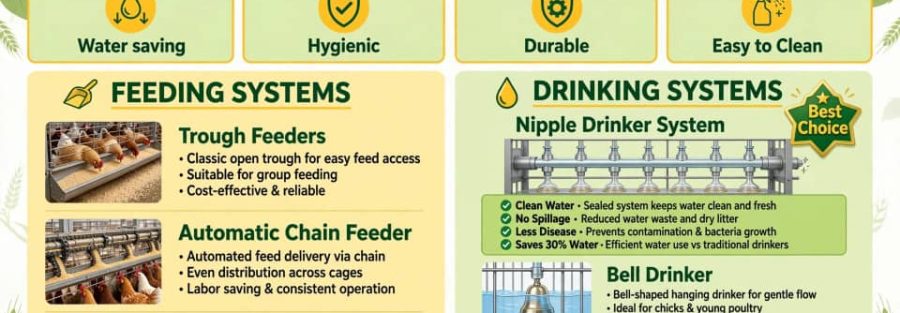
1. Trough Feeding Systems
Trough feeders are among the most common feeding systems used in poultry cages. They consist of long feeding channels positioned along the front of the cages, allowing several birds to feed at the same time.
Trough feeders can be manually filled or connected to an automated feed delivery system.
Advantages of trough feeders
Easy for birds to access
Suitable for layer cages
Simple to clean and maintain
Can accommodate many birds
Compatible with automatic feed distribution systems
Helps farmers monitor feed consumption
For small and medium-scale poultry farms, properly designed trough feeders can provide a practical and affordable feeding solution.
2. Automatic Chain Feeding Systems
For larger commercial farms, automatic poultry feeding systems can significantly reduce labor requirements.
An automatic chain feeding system distributes feed along the cage rows using a motorized mechanism. Once the system is switched on, feed is transported through the feeding channels, providing birds with regular access to feed.
This system is particularly useful for large layer farms where manually distributing feed would require considerable time and labor.
Benefits include:
Reduced labor costs
Consistent feed distribution
Less physical work for farm workers
Improved feeding efficiency
Better management of large poultry houses
Reduced chances of uneven feed distribution
3. Pan Feeding Systems
Pan feeders are another popular option, particularly in automated poultry production systems. Feed is delivered into circular feeding pans, allowing birds to feed around the pan.
Pan feeding systems can be designed to distribute feed automatically at predetermined times or quantities.
They are especially useful where farmers want greater control over feeding and reduced feed wastage.
4. Nipple Drinking Systems
When it comes to drinking systems for poultry cages, nipple drinkers are one of the most efficient choices for modern poultry farms.
A nipple drinker releases a small amount of water when a bird activates the nipple with its beak. This helps provide fresh water while minimizing unnecessary water spillage.
Advantages of nipple drinkers
Provide cleaner drinking water
Reduce water wastage
Minimize wet areas around cages
Reduce contamination
Require less daily cleaning than open drinkers
Suitable for automated poultry houses
Farmers should ensure that nipple drinkers are installed at the correct height and water pressure to make them easily accessible to birds.
5. Cup Drinkers
Cup drinkers are another option for poultry cages. They are usually installed beneath or alongside nipple systems and provide a small cup where water collects after being released.
They can be useful where farmers want to minimize water loss while making water access easier for birds.
However, cups need regular inspection and cleaning because dirt, feathers, and feed particles can accumulate inside them.
6. Water Lines and Automatic Drinking Systems
A complete automatic poultry drinking system normally includes water pipes, regulators, filters, nipple drinkers or cups, and other components required to deliver water throughout the poultry house.
Water pressure should be properly regulated to prevent excessive leakage or insufficient water flow.
Farmers should also consider installing water filtration systems, particularly where the farm’s water source contains sediment or impurities.
How to Choose the Best Poultry Feeding System
The best feeding system depends on several factors.
Farm size
Small poultry farms may find manual or semi-automatic feeders more affordable, while large commercial farms can benefit from fully automated systems.
Number of birds
As flock size increases, automation becomes more valuable because it reduces the amount of labor required for daily feeding.
Budget
Farmers should consider both the initial installation cost and long-term maintenance expenses. The cheapest system is not always the most economical if it creates significant feed wastage or requires frequent repairs.
Cage design
Feeding and drinking equipment must be compatible with the cage dimensions and bird type. Proper installation ensures that birds can comfortably access feed and water.
Maintenance
Choose systems that are easy to inspect, clean, repair, and replace when necessary.
Tips for Reducing Feed and Water Wastage
Even the best equipment will not perform efficiently if it is poorly managed. Farmers should:
Avoid overfilling feeders.
Adjust feeder height according to bird size.
Check feed lines regularly for blockages.
Inspect nipples for leakage.
Maintain appropriate water pressure.
Clean water lines regularly.
Monitor daily feed and water consumption.
Repair damaged equipment immediately.
Keep feed storage areas dry and protected from pests.
Train farm workers on correct equipment operation.
Why Choose Quality Poultry Equipment?
Investing in quality poultry cage feeding and drinking equipment can help farmers improve farm efficiency while maintaining better hygiene and bird welfare.
Good equipment should provide reliable access to feed and water, reduce wastage, withstand regular use, and be easy to maintain. Proper installation is equally important because poorly installed equipment can lead to uneven feeding, water leakage, and unnecessary expenses.
Partner with Aaron Vet Farms Ltd
Choosing the right poultry equipment can be challenging, especially for farmers establishing a new poultry house or upgrading an existing farm.
Aaron Vet Farms Ltd supports poultry farmers with practical solutions for better poultry production, including guidance on poultry housing, feeding, drinking systems, flock management, and general farm practices.
Whether you are starting a small layer project or developing a commercial poultry farm, selecting the appropriate feeding and drinking system for poultry cages can make a significant difference in productivity and profitability.
Contact Aaron Vet Farms Ltd for professional guidance on poultry farming solutions and equipment suitable for your farm.