
How Charcoal Can Help Broiler Chickens: Benefits for Health, Litter Quality and Poultry Production
Discover how charcoal can help broiler chickens by improving litter quality, reducing moisture and supporting poultry health. Practical charcoal tips from Aaron Vet Farms Ltd.
Broiler farming is one of the most popular poultry enterprises because chickens grow quickly and can provide farmers with a reliable source of meat and income. However, successful broiler production depends on more than providing feed and water. Farmers also need to maintain good litter quality, proper ventilation, hygiene and overall flock health.
One management tool that has attracted attention in poultry production is charcoal, particularly properly prepared biochar or activated charcoal. Research has investigated charcoal as both a litter amendment and a feed additive, with potential benefits related to moisture management, litter quality and some aspects of bird health.
At Aaron Vet Farms Ltd, farmers should understand that charcoal is not a replacement for quality feed, vaccination, biosecurity, clean water or veterinary care. Instead, when the appropriate charcoal product is used correctly, it can be considered as one part of a good broiler management program.
1. Charcoal Can Help Control Moisture in Poultry Litter
Wet litter is a common problem in broiler houses. Excess moisture can create an uncomfortable environment for chickens and contribute to problems such as footpad dermatitis and increased ammonia production.
Biochar has a porous structure and a large surface area, allowing it to absorb and retain moisture. A commercial broiler study found that adding biochar to pine-shaving litter increased its water-holding capacity.
Keeping litter drier can therefore contribute to a cleaner and more comfortable poultry house.
However, charcoal should not be used as a substitute for identifying the cause of wet litter. Farmers should also check leaking drinkers, excessive stocking density, poor ventilation, digestive problems and unsuitable litter materials.
2. It May Help Improve Litter Quality
Good litter management is essential for successful broiler farming. Charcoal or biochar used as a litter amendment can help change the physical properties of litter, particularly its ability to retain moisture.
A 2026 study reported that biochar-amended poultry litter reduced bacterial counts in the litter and air environment and improved several indicators of environmental hygiene and bird immune status.
This makes biochar an interesting option for farmers looking for additional approaches to poultry-house management.
3. Charcoal May Help Reduce Problems Associated With Wet Litter
Wet litter can contribute to footpad problems in broilers. When birds spend much of their time standing on wet or poorly managed bedding, their feet are exposed to unfavorable conditions.
Research involving charcoal supplementation reported improved footpad health in broilers, although the study did not find a significant improvement in body weight or several other production measurements.
This is important because it shows that charcoal should not be marketed as a guaranteed growth promoter. Its potential value may be greater in litter and environmental management than simply expecting bigger chickens.
4. Charcoal Has Adsorption Properties
One reason charcoal is studied in animal production is its ability to adsorb certain substances because of its porous structure.
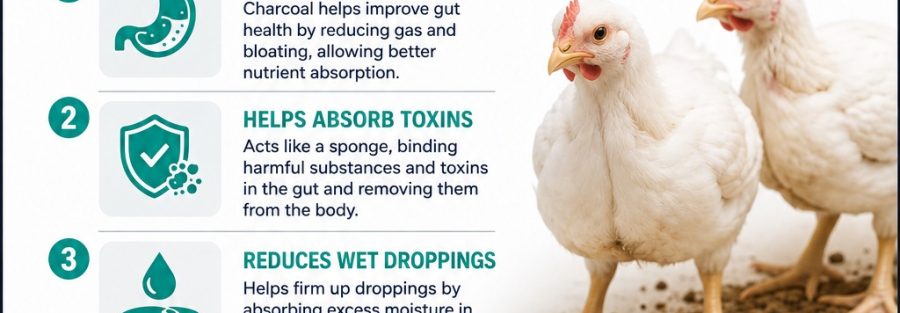
Activated charcoal is particularly known for its adsorption capacity. Research on broilers has investigated charcoal and activated-charcoal products for their potential effects on intestinal conditions, toxins and microorganisms. Some studies have reported positive effects, while others have produced mixed results.
For this reason, farmers should use poultry-approved charcoal or biochar products rather than assuming that ordinary household cooking charcoal is suitable for chickens.
5. Charcoal May Support Broiler Health
The relationship between charcoal and broiler health is an area of ongoing research. A recent study found that dietary biochar supplementation was associated with improvements in growth performance, feed efficiency, bone mineralization, footpad health and some immune responses.
Another study on an activated-charcoal and herbal extract combination reported improvements in growth performance and some immune-related measurements at a particular supplementation level.
These findings are promising, but results can depend on the type of charcoal, source material, processing method, dosage and method of application.
6. It Can Be Part of Sustainable Poultry Farming
Biochar can also fit into sustainable agriculture because it can be produced from carbon-rich agricultural materials. Properly produced biochar can have applications in poultry litter management and other agricultural systems.
For poultry farmers, this creates an opportunity to explore management practices that improve resource efficiency while maintaining good animal welfare and hygiene.
7. Do Not Confuse Cooking Charcoal With Activated Charcoal or Biochar
This is one of the most important points for poultry farmers.
Not all charcoal is the same.
Cooking charcoal, activated charcoal and agricultural biochar have different properties and uses. Activated charcoal is processed to increase its adsorption capacity, while agricultural biochar is generally produced for environmental or agricultural applications.
Therefore, farmers should not simply crush ordinary charcoal and mix large quantities into broiler feed.
If charcoal is being considered as a feed additive, farmers should obtain a product specifically intended for poultry and follow the manufacturer’s or veterinarian’s recommended dosage.
8. Charcoal Is Not a Replacement for Good Broiler Management
Charcoal can potentially complement a poultry management program, but it cannot replace the fundamentals of successful broiler farming.
Farmers should continue to provide:
High-quality broiler feed
Clean and adequate drinking water
Proper ventilation
Appropriate stocking density
Dry, clean litter
Proper brooding temperatures
Vaccination according to a suitable program
Regular monitoring of bird health
Good farm biosecurity
Prompt veterinary attention when birds become sick
Good management remains the foundation of profitable broiler production.
How Should Farmers Use Charcoal?
The safest approach is to first determine why charcoal is being considered.
If the objective is litter management, use an appropriate agricultural biochar product according to recommended application instructions. Research has shown that biochar can increase litter water-holding capacity and may improve litter conditions.
If the objective is dietary supplementation, use only a poultry-appropriate product and follow professional guidance on dosage. Different charcoal products can behave differently, so copying a dosage from another study or farm may not be appropriate.
Farmers should also monitor litter moisture, ammonia levels, bird behavior, footpad condition, feed intake, weight gain and mortality to determine whether the management practice is actually helping.
Final Thoughts
Charcoal, especially properly produced biochar and poultry-grade activated charcoal, has potential applications in broiler production. Its porous structure can help with moisture management, while research suggests possible benefits for litter quality, footpad health and certain aspects of broiler health.
However, charcoal is not a magic solution for broiler farming. The best results come from combining appropriate charcoal use with good nutrition, hygiene, ventilation, vaccination, biosecurity and professional veterinary management.
For farmers looking to improve their poultry production, understanding the correct type, purpose and application of charcoal is essential.
Aaron Vet Farms Ltd supports poultry farmers with practical approaches to better flock management, poultry health and productive farming. Always consult a qualified poultry veterinarian or livestock professional before introducing a new feed additive or litter treatment into your flock.